The instrumentation used for the design and qualifications of cold chain packaging systems have advanced considerably in the past couple of decades. As cold chain began as a regulated industry it was not uncommon to see homemade mechanisms used to prove that packaging systems functioned correctly. Historically, qualification methods have ranged from using heat blankets, space heaters, or air conditioning units in a confined space around a sample to simply leaving a sample outside in the sun or the trunk of an automobile. Today, temperature-controlled packaging solutions have advanced these qualification processes by utilizing precise instrumentation that’s traceable to recognized standards and test methods, while accurately replicating the real-world environments samples are expected to experience.
The thermal testing chamber, or environmental chamber, is one of the most iconic pieces of equipment seen in a cold chain lab today. Ranging in size from small units that resemble a college dorm room mini fridge, up to large modular walk-in units that could be seen at your local grocery store, the thermal testing chamber is key in qualifying a cold chain shipping solution. Most common units function as both freezers and heaters and are designed to mimic the rigors of a shipping lane. These environments can experience temperature changes of up to 30°C within an hour. Bolt-on options are also available to extend testing beyond the ambient thermal variables. These include humidity testing, which can heavily affect paper products; vibration testing to assess how shipping movement impacts the package; and solar heat lamps for scenarios involving long-term sun exposure.
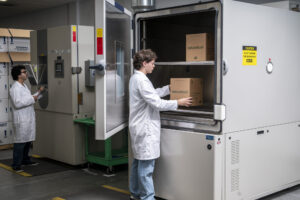
Refrigerators and Freezers are common instruments seen in a cold chain laboratory and are intended to condition packaging components in a manner typical to how the end user will condition the final packaging system.
Temperature readings are essential in a cold chain laboratory where thermodynamics drives many of the tests being performed. The most common device used is a thermocouple, a technology long relied upon for applications ranging from thermometers and control ovens to early nuclear detonation systems. A thermocouple consists of two metal wires that are welded together at their tip. A current is passed through the two wires, and the resistance is measured at the welded portion. This resistance is input into an equation based upon the metal of each wire to determine the temperature. Thinner wires are typically preferred for laboratory testing since they allow the least amount of thermal bridging or air gaps in the samples.
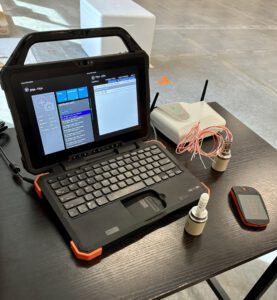
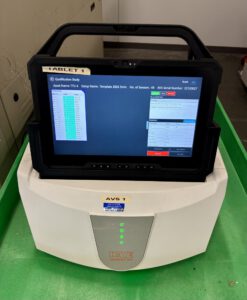
As thermocouples generate temperature readings, another device is required to log the data. Without one, an analyst would have to record the readings manually every 30 minutes for the entire 72-hour test, which is a challenging task. In the past, individual wireless loggers would be utilized to record the data throughout the test and all data would then be assembled by an analyst upon test completion. While this method is still used for lane testing, laboratories now utilize an array of thermocouples that insert into a singular system to record readings of all thermocouples at set intervals. The newer data logging systems such as the Kaye AVS Validator also use a data integrity and user interface system that ensures compliance with CFR 21 Part 11 and prevents accidental altering of data by an analyst.
For further information about key instruments used in a cold chain laboratory, contact us today!

Written by Andrew Klasek, Thermal Design and Innovation Lab Director.
Andrew began his career in the Environmental Chemistry field before coming to the packaging world where he currently runs the EFP Cold Chain Laboratory which develops shipping solutions for pharmaceutical and food shipments. Andrew also participates in the creation of whitepapers and industry guidance documents with the ISTA Pharma Committee covering topics such as developing temperature profiles for testing, lane testing, and simulation software.